We’re Atlassian’s Partner of the Year 2026 Co-Selling Excellence and Cloud Transformation Services
Read more
Skip to main content
What is the human cost of AI transformation?
Share on socials

What is the human cost of AI transformation?

Neal Riley
Neal Riley
Published on 16 June 2026
5 min read
Two people looking at a screen with an AI data wave behind them
Neal Riley
Neal Riley
Published on 16 June 2026
5 min read
Uncover the full picture
From AI experimentation to AI expectation
What is the human impact of AI transformation?
A preview of the findings
What does it take to win with AI?
Your questions answered

Unlock human potential with AI

Our research doesn't just reveal the human cost of AI—it sets you on the path to tackling it. Start building an AI strategy that truly unlocks human potential.

AI is transforming work, but how is it actually impacting your people? New research by Adaptavist explores the tension between technological progress and worker experience—and how to get ahead.

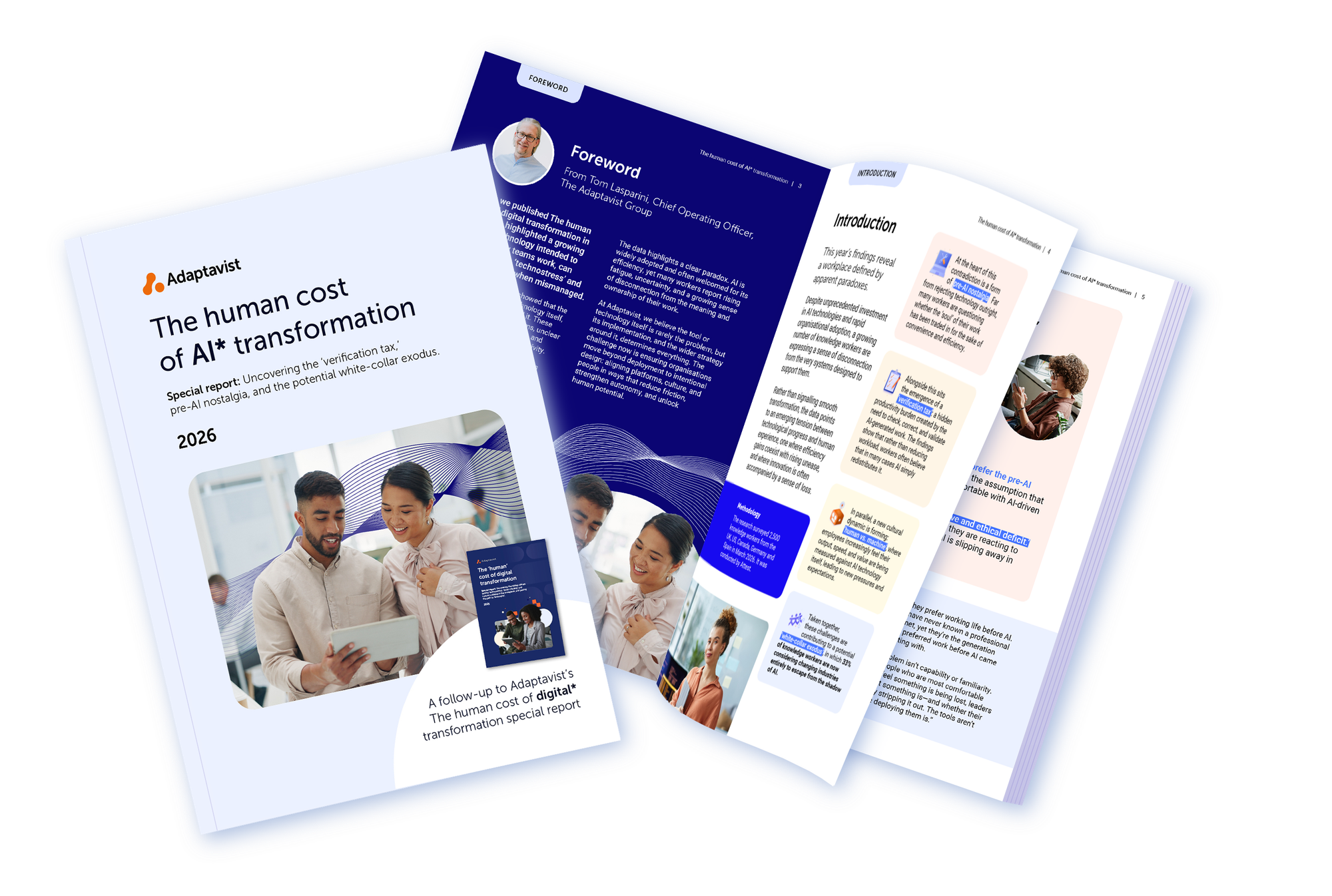
In October 2025, we published our report ‘Understanding the human cost of digital transformation’. We wanted to explore if digital transformation really results in empowerment for knowledge workers, or if it had become a burden, causing stress, disconnection, and uncertainty.
It revealed effects like ‘technostress’—the strain felt from constantly having to adapt to new tools—and the resulting ‘quiet cracking’, a silent decline in motivation that comes with technology mismanagement and a lack of real connection to work. These are key themes that appeared in the report, but what it highlighted was that new technology wasn’t really the problem. It was the context and the implementation culture surrounding it that created uncertainty for knowledge workers.

From AI experimentation to AI expectation

This time, we’re putting AI in the spotlight.
Since our last report was published, AI has moved from experimentation to expectation in the workplace. So with our new research report ‘Understanding the human cost of AI transformation’, we wanted to further explore how AI is being implemented in workplaces, how knowledge workers are really transitioning to new ways of working, and their views on what the future may hold.
We explore how AI is reshaping not just the way work gets done, but also people’s experiences of work and how they feel about their value at work, including their confidence in their own skills and their trust in the systems they’re part of.
In this blog, we give you a sneak preview of the report and its findings. So let’s jump in!

Special report: The human cost of AI transformation

The human cost of AI transformation report thumbnail image

What is the human impact of AI transformation?

Paradox is the word that springs to mind when you read through the findings. On the one hand, workers are adopting AI technologies at an unprecedented rate and acknowledge the efficiency gains they can unlock, while on the other, they are feeling disconnected and even in competition with the systems that were implemented to support them.
AI presents a fundamental shift in how work is structured. It’s not always removing effort, but redistributing it, from execution to verification, from creation to comparison, and from certainty to ambiguity.
There’s an undeniable tension between forging ahead to embrace new technology and the human experience that workers are living through as a result of this enthusiasm. Yes, efficiency might be easily won, but at what cost? And what are we losing in the process?
For some, there’s a longing for what once was, a nostalgia for simpler times when the meaning of work was clearer. For others, it’s an unwanted sense of competition with AI tools, a sense that their performance is always being compared—and that they’re the ones losing the battle.
Then there’s the labour shift. It appears there has been a redistribution of effort where the burden of manual work for humans has been replaced by humans checking the work of AI tools.
There’s another paradox, too, a more visible cost of AI transformation where knowledge workers are considering leaving altogether. They’re looking elsewhere—outside of their current job, their current industry, rejecting AI tools and pivoting to a new, more ‘insulated’ careers. But this is a choice, and other knowledge workers are diving into AI, retraining, upskilling, and buckling in for the ride.


A preview of the findings

Here are some of the headlines from the report:
  • Adoption is not the same as engagement, and one doesn’t guarantee the other: 36% of workers often don’t understand why they’re expected to use AI in their role, leading to AI fatigue.
  • AI can create more work and time pressures than it alleviates: 42% of workers spend more time verifying AI output than they save using it.
  • Some people are opting out. Others are going all in: while one in three knowledge workers are considering changing industries because of AI, 74% of workers are actively learning new skills to stay relevant in their field.

What does it take to win with AI?

Our research proves that ensuring the technology you’re using leverages AI where it’s most needed is only part of the puzzle. And McKinsey’s research validates our own—”technology alone doesn’t create competitive advantage; enduring capabilities do.”
This means business leaders also need to invest in reskilling and upskilling initiatives, and creating a culture where open, honest dialogue around AI is encouraged. And indeed, the data shows people want to learn—but it’s up to business leaders to create cultures which champion learning and development to support employees seeking to future-proof their skills.
people collaborating at worl around laptop

Power-up your AI strategy

Discover how your teams really feel about the impact of AI—and how leaders can navigate the transition.

Your questions on 'The human cost of AI transformation', answered

What is ‘The human cost of AI transformation’?
The human cost of AI transformation is a new research report from Adaptavist. Building on the organisation’s 2025 report The human cost of digital transformation, it explores how AI is reshaping the way work gets done, and how that impacts people’s experiences at work.
The report includes findings based on a comprehensive survey of knowledge workers, alongside commentary from Adaptavist’s transformation experts and insights from our technology partners Atlassian, monday.com Tempo Software, and Rewind.
We surveyed 2,500 knowledge workers from the UK, US, Canada, Germany, and Spain in March 2026.
Key findings from the report highlight a clear paradox in AI transformation. While adoption is accelerating, many knowledge workers are struggling with its impact. A significant number feel nostalgic for pre-AI ways of working (65%), and over a third don’t fully understand why they’re expected to use AI, leading to fatigue and disengagement. 
Rather than saving time, AI can often shift effort, with 42% of workers spending more time verifying output than they save using it. Half feel their performance is being compared to that of AI, creating additional pressure. As a result, some are opting out, with one in three workers considering changing industries, while others are adapting, with 74% actively upskilling to stay relevant.
Those are just the headlines. For all the findings and in-depth analysis, read the full report .
It’s easy! Simply download here and start reading.

Unlock human potential with AI

Our research doesn't just reveal the human cost of AI—it sets you on the path to tackling it. Start building an AI strategy that truly unlocks human potential.
Written by
Neal Riley
Neal Riley
Co-Founder and GM, Salable
Neal was previously the CIO for Adaptavist and is a technology and AI expert. Still within The Adaptavist Group, Neal is Co-Founder and General Manager for Salable, an all-in-one SaaS monetisation platform.
AI
Digital transformation
Work management