Heading to Anaheim for Atlassian Team '26? Come and meet our experts!
Read more
Skip to main content

Tackling the AI-driven ‘white-collar exodus’

AI promised to revolutionise productivity. But research by Adaptavist shows that it isn’t always delivering.
Discover how the AI ‘verification tax’, emerging cultures of ‘human vs. machine’, and more are impacting team engagement—and how leaders can build a culture where AI thrives by unlocking human potential.
Loading animation...

AI adoption has exploded in the workplace

To follow-up on last year’s research into The human cost of digital transformation, we spoke to 2,500 knowledge workers about their experiences of AI in the workplace.
The data is clear—AI has officially moved from experimentation to expectation in the workplace.
Data representation visual

73%

Of workers say using AI at work enables them be more efficient
Data representation visual

67%

Would like their organisation to increase its use of AI technology
data representation visual

65%

Say their organisation has a clear strategy for how AI tools should be used

... but are workers truly engaging with it?

Swiss army knife icon

0%

Do not understand why they are expected to use AI in their role
Automations icon image

0%

Are frustrated that tasks requiring years of expertise can now be done by almost anyone using AI
strategy icon

0%

Would remove GenAI tools from the world altogether if given the choice

In fact, 65% of workers regularly feel nostalgic for how work operated before AI

The cognitive costs of AI at work

This emerging tension between technological progress and human experience is manifesting itself in a number of ways

The 'verification tax'

A hidden productivity burden created by the need to check, correct, and validate AI-generated work.
52% regularly correct AI-generated work from colleagues
Checklist icon

Human vs. machine

A dynamic where workers feel their output, speed, and value are measured against AI technology itself.
26% say AI results in rising pressure to improve performance
ai chat icon

Fear of obsoletion

A growing anxiety about long-term relevance in the workplace.
54% say they are concerned that AI could reduce the need for their role within the next five years
Accident icon

The white-collar exodus

As a result of these pressures, a new structural risk is emerging.
33% say they are already considering changing industries due to AI
Cycle icon

Are your teams vulnerable to AI fatigue?

  • 25% of workers are actively exploring professions perceived to be less exposed to AI
  • 46% of C-level executives and 36% of directors say they are already considering changing industries, but;
  • 74% of workers are actively learning new skills to stay relevant in their field, rising to 85% among C-level leaders.
two female colleagues collaborating at work

With insights from leading technology providers

photo of Lisa Schaffer, Adaptavist Global Work Management Practice Head
We're asking people to move faster, work smarter, and embrace AI, while a growing number quietly wonder if there'll be a place for them at all. That tension doesn't just disappear. It shows up in your retention data, your engagement scores, and your culture.
But here's the opportunity: organisations that acknowledge this anxiety, and invest in their people alongside the technology, are the ones who will come out ahead. AI doesn't have to mean uncertainty. It can mean growth if we lead it that way.

Lisa Schaffer
Global Work Management Practice Lead, Adaptavist
Ophir Penso VP of GTM, monday.com
The real risk isn’t that AI replaces experts, it’s that organisations don’t give experts the right tools and guardrails to direct AI safely, so everyone stays stuck in low gear out of caution.

Mike Potter
Co-founder and CEO, Rewind
Neal Riley profile image
This research shows that leaders can no longer afford to overlook the human impact of AI adoption. If introduced without clarity or support, AI risks undermining confidence in hard-earned skills and fuelling unnecessary fear.
However, when implemented thoughtfully and transparently, AI has the potential to enhance roles, freeing people from repetitive tasks and enabling them to focus on more meaningful, high-value work. The priority for organisations now should be ensuring employees are equipped with the right training, context, and support to adapt.

Neal Riley
Innovation Lead, The Adaptavist Group

More expert insights for business leaders

Two people looking at a laptop together
Work management
Digital transformation

Digital transformation burnout: How to reduce technostress

In this blog, we explore how culture, change management, and practical support can flip the script from technostress to technojoy, where technology enables focus, autonomy, and satisfaction.
Read more
Person dressed smartly outside smiling
Work management

Technostress: Can technology help reclaim the work‑life balance?

This blog explores why constant connection can still leave employees feeling lonely, and provides practical ways your teams can leverage tools to reclaim work-life balance and become more productive.
Read more
Person working on a laptop smiling
Work management

How to create more 'technojoy' in your organisation

Learn to turn technostress and 'quiet cracking' into 'technojoy' with a supportive culture, clear leadership, better training, healthy digital boundaries, smart AI use, and jargon-free communication.
Read more
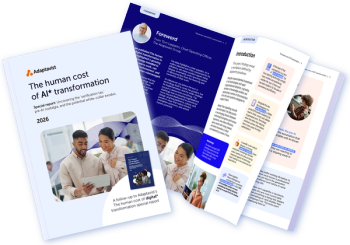
image of research report

Want to build an AI strategy that delivers clarity?

Download our report to discover expert insights from business and technology leaders on removing AI friction and designing a culture that supports human potential with technology.