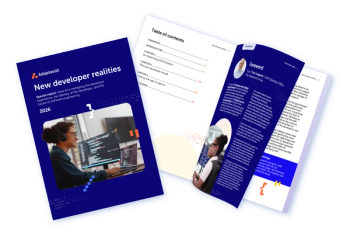
New report: Uncover the true impact of AI on your dev teams
Read more
Skip to main content
Changing developer realities: what AI means for the future of software engineering
Share on socials

Changing developer realities: what AI means for the future of software engineering

Matt Saunders
Matt Saunders
Published on 5 November 2026
6 min read
Person sat at a desk working across multiple computer screens
Matt Saunders
Matt Saunders
Published on 5 November 2026
6 min read
Changing developer realities
The developer experience is changing
The developer exodus
The new developer divide
The AI agent age
Put people at the heart of your AI strategy
FAQs: AI and changing developer realities

Special research report: Changing developer realities

How is AI really affecting your developers? Get the full findings and practical insights in this independent research report.

AI is reshaping how developers learn and work: 63% learn less through hands-on coding, and 82% now deploy multiple AI agents. Read the report ‘Changing developer realities’ for the full findings.

The developer experience is changing

AI is transforming software development, but what’s happening to the people expected to work alongside it? While productivity gains are real, the impact on developers’ experience, skills, and responsibilities is becoming harder to ignore
Our latest research, ‘’, explores how AI is reshaping developers’ work lives, from the pressure to demonstrate AI adoption to growing concerns about career progression and the rise of AI agents as everyday collaborators.
Commissioned by Adaptavist, the research surveyed 1,000 people in roles involving software development across the UK, the US, Germany, Spain, and the Netherlands. It follows our previous research into the human cost of digital transformation and AI transformation, which found that technology introduced without the right strategy, culture, and support can leave people stressed, disengaged, and nostalgic for how work used to be.
Now, we're looking at the people closest to the technology itself. And the findings reveal a paradox: developers are embracing AI and experiencing its benefits, yet many are also facing mounting pressure, uncertainty, and changes to their professional identities.
In this blog, we explore three of the biggest shifts emerging from the research: the risk of a developer exodus, the widening divide between developers at different career stages, and the new responsibilities that come with working in the age of AI agents.


The developer exodus: when productivity comes at a cost

AI promises to help developers work faster, improve code quality, and spend less time on repetitive tasks. And for many, it’s delivering. According to our research, 83% of developers say AI has made them more productive, while 81% believe it has made them better at their jobs.
But productivity tells only part of the story.
For many respondents, AI is making their job less enjoyable and more stressful than ever. With 60% also reporting that they’re being asked to do more with fewer resources, the pressure to deliver more isn’t translating into a better working experience.
One contributing factor is how organisations are depending on AI usage as a formal performance metric. When the focus shifts from the value developers deliver to how much AI they use, the incentive becomes adoption for its own sake. Indeed, 52% of respondents admit to using AI more often than they need to in order to meet organisational expectations. Add the extra work involved in reviewing, testing, and debugging AI-generated code, and the productivity benefits can quickly diminish.
Three people working on a computer together

Forget DevEx at your peril

In our next blog in this series, we’ll look at what you can do to stem the tide, starting by measuring outcomes rather than activity alone and protecting the time and autonomy people need to solve problems properly.

The new developer divide: who’s building tomorrow's skills?

The impact of AI is also changing how devs learn, progress, and prepare for the future.
Traditionally, junior developers have built their expertise through hands-on experience: writing code, fixing bugs, troubleshooting failures, and learning from more experienced colleagues. But as AI takes on more of these tasks, some of those opportunities are disappearing.
Our research found that 63% of devs say AI has reduced the amount they learn through hands-on coding, while 43% say they have fewer opportunities to upskill. The concern is shared across experience levels: 71% of experienced developers and 68% of early-career developers worry that junior colleagues are becoming overly reliant on automation.
Two people working together on a computer smiling

The new developer divide

In a future blog, ‘The new software developer divide – and how you can bridge the gap’, we’ll explore how bridging the developer divide isn’t about rejecting AI or slowing innovation; it’s to make skills development part of your adoption strategy. You need to protect opportunities for hands-on coding, invest in AI literacy across all career stages, and rethink how you assess performance and progression.
By investing in people as well as tools, businesses can help bridge the developer divide and build teams equipped for the future.

The AI agent age: from using tools to managing teammates

As AI becomes more capable, developers’ relationship with it is evolving. For many, AI is so much more than a tool. It’s becoming a teammate they delegate work to, coordinate with, and oversee. And this isn’t just a change in perception: our survey found that 82% of devs regularly deploy multiple AI agents for a task.
Engineering teams are increasingly responsible for orchestrating work across several agents, reviewing their outputs, and deciding when to intervene. In fact, 68% say managing agents is becoming an explicit part of their daily role. This is a core software engineering skill in the making.
For organisations, this creates a new management challenge: enabling developers to delegate effectively without losing control, accountability, or the ability to spot problems.
Two people smiling whilst looking at a computer monitor

A new era of AI orchestration

We’re going to dive deeper into what organisations can do to overcome this challenge in an upcoming blog, starting by defining which tasks agents can handle independently and which decisions require human approval. The goal is to create an environment where people can collaborate with agents safely and effectively, with clear responsibilities and the skills to manage the risks.

Put people at the heart of your AI strategy

All the findings from ‘Changing developer realities’ point to a common thread. Whether the challenge is declining job satisfaction, a widening skills gap, or the growing responsibility and compliance concerns of managing AI agents, technology alone isn’t the answer.
Developers need the freedom to use AI where it genuinely helps, the opportunity to build and maintain their expertise, and the support to take on new responsibilities confidently. Organisations, meanwhile, need to understand not just whether AI is being adopted, but also how it’s affecting software delivery, software quality, and the people working on it.
At Adaptavist, we believe technology itself is rarely the problem. How it’s introduced, measured, and supported is a much stronger predictor of success. That’s why we help technology leaders look beyond adoption rates and short-term productivity gains to really listen to their developers, invest in their skills, and create the right conditions for humans and AI agents to work well together.
cut out image of open research report

Want to understand what AI transformation really means for your developers?

Download the independent research report ‘Changing developer realities’ to explore the full findings, expert perspectives, and practical insights to help you adapt your AI strategy to the realities of modern software development.

FAQs: AI and changing developer realities

AI is taking on tasks that junior developers have traditionally learned from, such as writing code, fixing bugs, and troubleshooting. 63% of developers say AI has reduced how much they learn through hands-on coding, and 43% say they have fewer chances to upskill.
Yes, at every experience level. 71% of experienced developers and 68% of early-career developers worry that junior colleagues are becoming overly reliant on automation.
AI is moving from a tool developers use, to a teammate that they have to orchestrate. 82% of developers regularly deploy multiple AI agents for a task, and 68% say managing agents is becoming an explicit part of their daily role.
Build skills development into your AI adoption strategy. That means protecting opportunities for hands-on coding, investing in AI literacy at every career stage, and rethinking how you assess performance and progression.
It also means deciding which tasks agents can handle on their own, and which decisions need human approval.

Special research report: Changing developer realities

How is AI really affecting your developers? Get the full findings and practical insights in this independent research report.
Written by
Matt Saunders
Matt Saunders
DevOps Lead
Matt Saunders heads up DevOps for the CTO function at Adaptavist. In a career ranging from challenger banks to the largest multi-national enterprises, Matt has helped organisations deliver software safer and faster, particularly within the unique constraints of those in the finance sector. Matt firmly believes that transformational work can be delivered even in the most constrained of companies.
DevOps
AI
Digital transformation