We’re Atlassian’s Partner of the Year 2026 Co-Selling Excellence and Cloud Transformation Services
Read more
Skip to main content
GitLab Transcend 2026: what you need to know about the agentic engineering era
Share on socials

GitLab Transcend 2026: what you need to know about the agentic engineering era

Melissa Hales
Melissa Hales
Published on 18 June 2026
8 min read
Image of a person on a computer with the GitLab logo
Melissa Hales
Melissa Hales
Published on 18 June 2026
8 min read
Jump to section
Next-generation source code management
GitLab Orbit
Governance for agents
GitLab Flex
Expanded GitLab and Google Cloud collaboration
Adaptavist at Transcend 2026: winning with managed services
What this means for your organisation

Agentic engineering is reshaping software delivery. Here's everything GitLab announced at Transcend 2026

At GitLab Transcend, the theme was clear from the opening keynote: the age of agentic engineering is here, and the infrastructure, governance, and commercial models built for human-speed delivery are showing their limits. Here is what was announced, and what it means for your organisation.

Speed with control: the big idea

GitLab CEO Bill Staples opened by framing the core tension: speed without control leads to chaos. GitLab research across more than 1,500 developers and tech leaders shows that 91% of organisations now run two or more AI coding tools, with some codebases growing 5-fold within a year. But only 21% see productivity gains across the full software development lifecycle, and 73% worry about the maintainability of the AI-generated code.
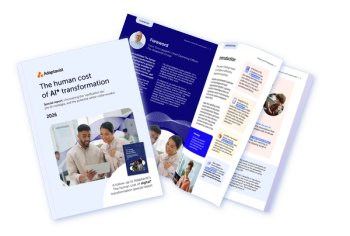
Image of The human cost of AI transformation report

The human cost of AI transformation

The challenges GitLab's research highlights reflect a broader pattern. Our own research explores what AI adoption is really costing organisations — and the people inside them.
GitLab’s answer is agentic infrastructure built on four interconnected systems: a high-performance and reliable “motor” for execution at agent scale, a “nervous system” for lifecycle context, an "immune system" to keep you safe via governance and security, and a "brain" to act as the orchestration and coordination system, to coordinate all three. The exciting announcements at Transcend each address a part of this architecture.

Next-generation source code management

Git was designed for humans working at human speed. When AI agents begin cloning entire repositories just to read or change a handful of files, existing and structural bottlenecks rapidly compound and collapse at scale. Some AI labs have already resorted to building custom workarounds to keep their development and maintenance workflows running on top of Git.

GitLab’s response, developed in collaboration with Anthropic and now in private beta, lets agents query the repository server-side for exactly the data each task requires, with each agent limited to the minimum visibility required by its task. The extensively redesigned backend, whilst retaining previous version compatibility, also separates compute and storage, so each can scale horizontally independently, which is a liberating architectural shift for teams running agents at scale across large codebases.

GitLab Orbit: context graph for the entire software lifecycle

One of the most significant announcements at Transcend, GitLab “Orbit” is now in public beta. Agents fail, or produce work that teams end up reverting when they lack full lifecycle context. In large monorepos and multi-repository environments, they frequently over-iterate, needlessly burn tokens, and poorly reconstruct what they cannot see or hallucinate.
Orbit continuously maps code, work items, pipelines, deployments, and production signals into a single live network graph that agents and engineers can query from the same source of truth. It currently supports 11 programming languages and can index an entire GitLab instance in minutes. Early internal testing shows agents grounded with Orbit were up to 11x faster, used up to 4.5x fewer tokens, and produced up to 45x fewer hallucinations. Orbit also runs as a standalone data product with open APIs, making the same context layer available to third-party agents and tools, including Claude Code via MCP. What stands out is the speed of deployment: the index engine can map work into code graphs and across the full SDLC at scale in just 15 minutes. For teams managing hundreds or thousands of pipelines and projects, Orbit Chat also enables review at scale in a way that standard GitLab Duo agents, lacking that rich and complete context, simply cannot match.

Governance for agents

Governance for agents, now in private beta, puts identity, policy, audit, and approval controls around every agent action. When agents push code, touch dependencies, and trigger deployments at scale, teams can lose track of which agent acted, under which policy, and who approved it. The new capabilities provide real-time visibility into inputs, reasoning, tool calls, and anomalous activity, with a full audit trail already in place when unexpected events occur. It further extends GitLab’s Duo Agent Platform, which has been generally available since January 2026 and already includes out-of-the-box agentic workflows for code review, fixing failed pipelines, and SAST vulnerability prioritisation and resolution.

GitLab Flex

GitLab Flex is a new commercial structure that acknowledges how unpredictably organisations now consume software tooling. In the agentic era, the number of seats, AI usage and consumption, and platform capability requirements can shift significantly throughout the year. Traditional fixed-seat subscription contracts were built for a different world.
GitLab Flex is one annual commitment covering platform seats, GitLab Credits (for AI usage), usage ceilings and new eligible capabilities as they become available. Organisations can adjust their monthly reservations across all three as needs shift, without requiring contract amendments. A pay-as-you-go option is also available for teams that need even more flexibility.

Expanded GitLab and Google Cloud collaboration

Alongside the product announcements, GitLab also announced a managed GitLab offering on Google Cloud, delivered by GitLab-certified managed service providers, particularly relevant for organisations with data sovereignty or regulated requirements, who need to run the full GitLab platform while maintaining control over where their code, pipelines, and security data reside. Additionally, the latest Gemini 3.5 models are now available in the GitLab Duo Agent Platform, and Gemma 4 is available for GitLab Duo self-hosted customers.

Adaptavist at Transcend 2026: winning with managed services

Adaptavist had a presence at the partner afternoon alongside the main event. Our Head of Sales, Ben Boswell, and Head of Enterprise Delivery, Fraser Scallan, took part in the “Winning with MSPs” fireside chat, sharing how we work with our customers to run GitLab as a fully managed service. As the agentic era rapidly accelerates both adoption and complexity, the case for managed services has never been stronger. Customers want to focus on addressing their business needs and unlocking the benefits of GitLab’s rapidly evolving platform without operational overhead. Our GitLab managed services are built exactly for this.
person looking at a circuit board with a GitLab logo

Run GitLab without the operational overhead

The agentic era is accelerating both adoption and complexity. Our GitLab managed services are built to help your team focus on business outcomes, not platform operations, covering everything from implementation and migration to ongoing management, security, and compliance.
As a GitLab Select and GitLab Professional Services Partner, we take care of the complexity so you don't have to.

What this means for your organisation

As a GitLab Select and a Professional Services Partner, Adaptavist helps organisations extract maximum value from GitLab across the full DevSecOps lifecycle, from implementation, migration, and integrations, to training, licensing, and ongoing managed operations.One theme that resonated strongly throughout the day: security remains the number one concern for organisations adopting AI tooling. GitLab's platform approach, with built-in governance, compliance controls, and human-in-the-loop approval, directly addresses this. As agentic adoption accelerates, so does the complexity of running these environments well, and that is precisely where Adaptavist's managed services come into their own.
Whether you are already running GitLab and want to understand how these new capabilities apply to your environment, or are exploring whether GitLab is the right platform for your next step in DevSecOps maturity, we are well placed to help.

Get in touch to start the conversation.

Explore our GitLab services and solutions
Written by
Melissa Hales
Melissa Hales
Principal Strategic Solutions Marketing Manager - DevOps