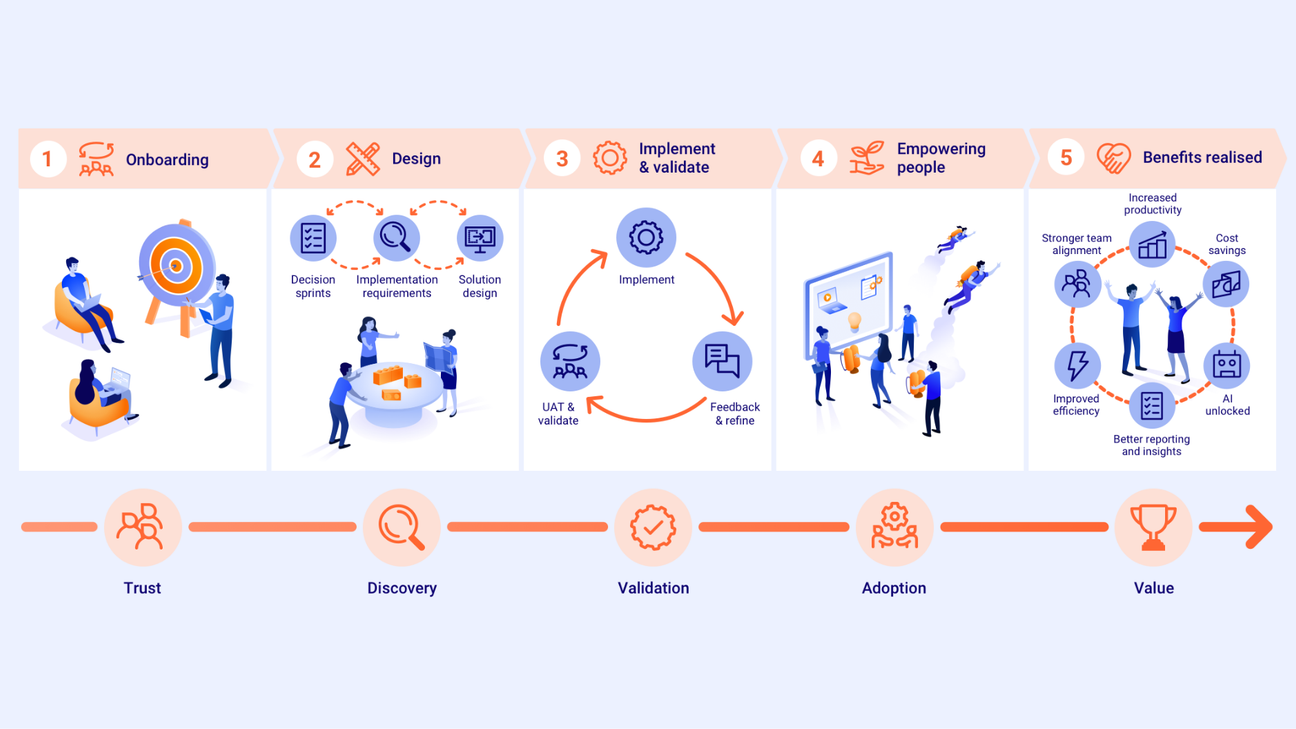
Onboarding is where the foundation is established. This phase is about people before technology: identifying who the transformation will impact across the business, building trust through structured stakeholder engagement, forming steering groups with the right authority, and aligning on goals before any solution design begins. Organisations that skip this phase and go straight to platform configuration are building on sand. Without genuine alignment at leadership level, every design decision becomes a negotiation, and every go-live becomes a battle for adoption.
Design follows an iterative model centred on discovery. Rather than documenting what exists and rebuilding it elsewhere, the design phase interrogates current processes through decision sprints and structured workshops, where the team works through the choices that will define the new service management model. The goal is not to preserve legacy complexity but to arrive at a solution grounded in what the business actually needs, informed by ITIL best practice and the capabilities of the platform. This phase produces clear implementation requirements and a solution design that stakeholders have genuinely shaped.
Implement and validate takes an iterative approach to ensure the solution aligns with organisational goals. Configuration is built incrementally, tested through User Acceptance Testing cycles, and refined based on direct feedback. This is not a linear build-then-test sequence; it's a loop. Feedback informs changes that are retested before moving forward. The result is a platform configuration that has been validated by the people who will use it, not simply signed off by a project manager.
Empowering people is the phase that most migrations don't have a meaningful equivalent for. Rather than standard end-user training delivered in the week before go-live, this phase invests in building genuine capability inside the organisation through; role-based enablement, solution management training, and the kind of confidence-building that allows teams to own the platform rather than depend indefinitely on external support. This is the difference between a team that can evolve their service management model as needs change, and a team that raises a support ticket every time they need to adjust a workflow.
Benefits realisation closes the loop. A transformation programme should define success in measurable terms from the outset; productivity, cost, adoption rates, AI readiness, and then actively track and report against those metrics. This phase ensures that the investment made in the transformation translates into documented, visible outcomes that justify the approach and inform the next stage of evolution.
How to tell whether you need a migration or a transformation
Not every ITSM project requires a full transformation programme. If your current processes are well-designed, your data is clean, and the only thing that needs to change is the underlying technology, a more targeted migration may be appropriate. But in practice, that description fits very few large organisations. This also depends on the platform you’re moving to. Not all platforms are compatible for a direct transfer of data.
The honest diagnostic questions to ask are these:
Are your current processes genuinely fit for purpose, or have they accumulated workarounds and exceptions over the years? If your teams regularly go outside the tool to get work done, such as through email, spreadsheets, or informal channels, that's a signal that the process design isn't working, not just the platform.
Do your service management teams and the business teams they share a consistent understanding of what good looks like? If IT and the wider organisation have different expectations of service levels, response times, and fulfilment processes, a platform change alone won't close that gap, because the gap isn't technological.
Have your senior leaders aligned on what they want service management to achieve, not just in terms of cost reduction, but in terms of business outcomes? Transformation programmes succeed when they are driven by strategic intent. If the programme is owned only by IT and framed purely as a cost reduction exercise, it will be treated as one, and the broader organisational value will never be unlocked.
If the honest answers to these questions reveal underlying problems beyond the technology, a migration will not resolve them. A transformation will. The distinction is worth being clear-eyed about before committing to an approach. If you aren’t able to have an unbiased lens, it may be worth requesting a discovery consultation from a trusted solution partner.
The question isn't just where you're going but where do you want to be as an organisation?
The decision to move away from a legacy ITSM platform is one that increasing numbers of enterprise organisations are facing. The combination of rising costs, limited value realisation, and inaccessible AI functionality is pushing leaders to reassess whether their current investment is justified, and for many, the honest answer is that it isn't.
But the value of the next decision won't be determined by which platform you choose. It will be determined by how you approach the transition. A migration gets you onto a new platform. A transformation gets you to a better operating model that is simpler, more standardised, more aligned across the business, and genuinely positioned to take advantage of what modern service management makes possible.
If you're a senior leader evaluating your options, the most important question to bring to that conversation isn't "which tool should we move to?" It's "what kind of service management organisation do we want to be and are we prepared to build it properly?"