Join Adaptavist and The Adaptavist Group at Team '26 in Amsterdam | 6-8 October
Read more
Building an AI-positive culture that works
Share on socials

Building an AI-positive culture that works

Shams Chauthani, Chief Technology Officer at Tempo Software
Shams Chauthani
Published on 22 September 2026
9 min read
Person looking at a laptop screen with an orange AI wave behind them
Shams Chauthani, Chief Technology Officer at Tempo Software
Shams Chauthani
Published on 22 September 2026
9 min read
Special report
Name the fear, not the feature
Let leaders go first and go public
Reward the workflow change, not just the output
Make room for the bad first drafts
Make space for feedback
Treat skill-building as an ongoing habit
The bigger point

Rolling out AI tools is easy. Building genuine trust around them isn't. One leader's honest look at fear, messy first drafts, and what actually changes minds on AI at work. Read the blog.

A few months ago, someone on my team said something that stuck with me: "I don't want to look lazy for using AI." We'd rolled out tools, run the demos, sent the Slack announcements – and people were still hiding their prompts like contraband.
Most companies get the technology part of AI adoption right. Fewer get the culture part right – and that is the part that actually decides whether any of it sticks.
Here at Tempo, we've been rolling out AI-assisted engineering practices, building a comprehensive context layer for all of product development, and doing our best to manage a huge shift in the way people work and learn.
Here's what I've learned, mostly the hard way, about building a workplace where people are genuinely excited to use AI rather than quietly afraid of what it means for them.

Start by naming the fear, not the feature

Every AI rollout doc I've seen leads with capabilities. Almost none of them lead with the question people are actually asking, which is some version of "does this replace me?"
Skipping that question doesn't make it go away. It just means people work it out on their own, usually in the least generous way possible. So say it out loud early. Be specific about what AI is for and, just as important, what it isn't for.
Vague reassurance ("don't worry, we value our people") does nothing. Concrete reassurance – this tool handles the first draft of your status report; you still own the judgment calls – actually lands.
That fear isn't isolated to one nervous engineer. Adaptavist's Understanding the human cost of AI transformation report surveyed 2,500 knowledge workers this year, and 54% said they're concerned AI could reduce the need for their role within five years.
Meanwhile, 52% regularly correct AI-generated work from a colleague – the quiet, unglamorous cost some are calling the 'verification tax.' And 65% admit to feeling nostalgic for how work operated before AI showed up.
None of that means people hate the technology. Yet 73% say it makes them more efficient, and 67% want their organisation to use more of it, not less. This isn't adoption versus resistance. It's competence and anxiety, sitting in the same person, most days.

Let leaders go first and go public

If the only people using AI tools are individual contributors experimenting on the side, you've told your whole company something important: This is optional, maybe even a little embarrassing.
You have to be big and loud about using them in front of your teams – and be messy with it. When I began introducing AI, I was sharing the messy, real versions in Slack, not the final polished version.
We're all in the middle of a massive new learning curve, but no one wants to look like they are behind. I found the best way to get people talking and experimenting is to dive in yourself and show your flaws as well as where you flourished to spark conversations.Show the prompt that didn't work. Admit the output needed three rounds of editing. When a leader people trust posts "AI got me 80% of the way there, and I still had to do the last 20% myself," that's worth more than any adoption metric on a dashboard.

Reward the workflow change, not just the output

This is the one companies miss most often. You can't ask people to change how they work and then keep measuring them the same way you always did.
If someone finds a faster path to the same result using AI, that's a win worth naming in a performance conversation, not something to quietly absorb into 'productivity'. Otherwise, you're sending a mixed signal: We want you to adopt new tools, but we'll evaluate you as though you didn't.

Make room for the bad first drafts

AI tools are genuinely useful and also inconsistent. Some outputs are great. Some are close. Some are just wrong in a confident tone that makes the wrongness harder to catch.
An AI-positive culture treats this as normal, not as a reason to swear off the tool. Build in a habit of checking AI output the way you'd check a junior teammate's first draft – with curiosity, not suspicion, and with an expectation that editing is part of the job now.
A lot of people are used to controlling all aspects of their work and are very proud of the final result – and just because AI can produce a passable first draft quickly doesn't mean we should expect everything to be done at rapid speed without proper time to check and analyse.
The part that can catch people off guard is that AI output always requires active review, not just acceptance. It's fast, but it doesn't know your context – the customer relationship, the internal constraint, the thing that wasn't written down.
It reminds me of when you first get into senior management and learn to delegate tasks you used to be an expert on to other people.
It doesn't mean the entire process is done without your input – just that a bulk of the task is moved away from you, but you still need to factor in time and effort to review. The difference with AI is that it isn't going to get skilled up like a junior – you always have to keep that vigilance.
Teams that got this right treated the AI's draft as a starting point that still needed human judgment applied to it. Teams that struggled expected it to calibrate itself over time – it doesn't.

Give people a real way to say "this isn't working"

Somewhere between blanket enthusiasm and blanket resistance, there needs to be a channel for the honest middle ground: This tool is useful for X, but actively gets in my way for Y.
Without that channel, you get silent workarounds – people quietly reverting to the old way and telling nobody. With it, you get the feedback that actually improves the rollout. A quick Slack channel, a monthly retro, even a five-minute survey. The mechanism matters less than making it genuinely safe to use.

Treat skill-building as an ongoing habit, not a one-time training

One workshop doesn't build a habit. The teams that get real value from AI tools are the ones where sharing a good prompt, a useful workflow, or a surprising failure has become a normal part of how teams talk to each other.
Give people the space to do this. Fifteen minutes at the start of a team meeting. A shared doc of prompts that worked. Whatever fits your team's rhythm, as long as it happens regularly enough to become a habit rather than an event.

The bigger point

None of this works if AI positivity is treated as a top-down mandate. People adopt tools they trust, and trust is built by being honest about the trade-offs, transparent about the failures, and consistent about how the change actually affects their day-to-day work.
There's a design decision that rarely gets discussed in these conversations: The way you architect your measurement systems either reinforces the culture you're trying to build or undermines it.
When we built Workforce Intelligence to track AI investment and attribution, we made a deliberate choice to work at the metadata layer – session IDs, branch names, token counts – not prompt content. Engineers will use AI more openly when they trust that the data you're collecting isn't being used as a surveillance layer. That trust starts with how the tool is built, not just how it's communicated.
Today, the same engineer I remember saying they didn't want to look lazy has their own custom routines running in Claude Code. When I asked them how they got there, they were very honest with me.
They told me they got to that point because it had just become a smart move. They saw others trying and talking about it, starting messy, and collaborating on something until it became useful – exactly the kind of things any engineer is happy to hear about.
That is a victory for culture. No one was being told what to do, or felt their job was on the line if they didn't start producing. There was interest, space and time made for the messy creation process, and the results followed.
Get the culture right, and the tool adoption tends to follow on its own. The teams you've trusted to get the job done all this time will do it again.
If this is the conversation your team keeps circling without landing anywhere, our AI Anxiety Panel might help.
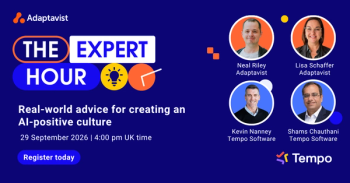
On Tuesday, 29 September, Tempo Software's CPO, Kevin Nanney, and I are joining Adaptavist for a virtual conversation on what workplace AI anxiety is actually telling leaders, and what to do about it before people start quietly heading for the door.

The Expert Hour: Real-world advice for creating an AI-positive culture

The Expert Hour with Tempo Software

Register to join The Expert Hour LinkedIn live event, ‘Real-world advice for creating an AI-positive culture’ with Tempo Software.
Written by
Shams Chauthani, Chief Technology Officer at Tempo Software
Shams Chauthani
Chief Technology Officer at Tempo Software
Shams Chauthani is Chief Technology Officer at Tempo Software. He brings more than two decades of engineering leadership, including CTO roles at Otelier and Zilliant, where he led major platform transformations and scaled engineering teams.
AI
Work management
Digital transformation