Most organisations are adopting AI. Few can prove it's working. Here's what separates experiments from impact.
Most organisations have already felt the initial buzz of AI-assisted development. Developers are writing code faster. Productivity feels up. But then something strange happens: the overall delivery metrics don't move much. Or in some cases, stability gets worse.
This tension sat at the heart of a recent Adaptavist and GitLab webinar, where our experts explored what it actually takes to get meaningful, measurable value from agentic AI across the software delivery lifecycle. And it connects to something we've been researching more broadly: the gap between AI adoption and AI impact isn't just a technical problem. It's a human one too.
The numbers don't add up
The stats from the webinar are worth sitting with. According to the
Atlassian State of Teams report 2026, 89% of executives say AI has increased the speed of work. Yet only 6% feel confident they can point to a specific, organisation-wide return on investment. Non-strategic AI implementation is costing the Fortune 500 an estimated $161 billion annually in what the report calls a "fragmentation tax."
Our own research tells a similar story from the worker's perspective.
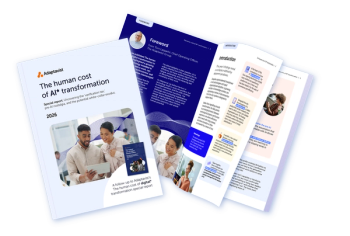
The human cost of AI transformation
We surveyed knowledge workers to understand how AI is really landing in the workplace. The findings reveal a gap between adoption and engagement that most organisations aren't accounting for.
36% of knowledge workers often don't understand why they're expected to use AI in their role. Adoption is happening, but it isn't the same as engagement, and one doesn't guarantee the other. For many workers, AI hasn't reduced the burden of work so much as redistributed it: less time executing, more time verifying and checking the outputs of tools they weren't properly onboarded to use.
When organisations treat AI as a deployment problem rather than a transformation one, this is what happens at scale.
The AI paradox is real
The issue isn't the technology. It's where organisations are applying it. When AI gets used purely as a faster way to write code, it compresses one phase of delivery while everything downstream stays the same. Reviews, security checks, testing, and deployment coordination all become the new bottleneck.
That's what happens when you view AI as spicy autocomplete without recognising its potential in the rest of the process.
Matthias Ewald
Partner Solution Architect, GitLab
Faster code generation without broader process change doesn't accelerate delivery. It just moves the constraint.
AI amplifies what's already there
DORA research cited in the webinar reinforces this point. A 25% increase in AI adoption was associated with a 1.5% decrease in delivery throughput and a 7.2% decrease in delivery stability. AI tends to increase productivity in well-performing organisations, but in operationally weaker ones it magnifies existing dysfunction. If your processes, governance, and team alignment aren't solid, AI will surface and accelerate those gaps rather than paper over them.
The shift isn't just left anymore
The industry has spent the past decade on "shift left": catching security and quality issues earlier in the pipeline, where they're cheaper to fix. That principle still holds. But agentic AI introduces a new axis. Matthias Ewald framed it as "shift up": moving teams above the delivery loop so they define the rules, set the policies, and let agents execute across the stages. The lifecycle doesn't disappear. The phases don't disappear. What changes is that the waiting, the manual handoffs, and the translation between stages can increasingly be automated.
Governing that new layer above the SDLC is quickly becoming one of the most important challenges in enterprise software delivery. Which agents can run? With what data? In which environments? Who is accountable when something goes wrong? These aren't edge-case questions. They're the core of whether an AI investment actually scales.
Three things you need before agents can operate at scale
Across the session, a few non-negotiables emerged for organisations that want to move beyond experimentation:
A strong DevSecOps foundation. Agentic AI doesn't replace the need for CI/CD controls, policy as code, identity and access management, or immutable audit trails. It makes them more important. Agents must operate within the pipeline, not around it.
Blast radius analysis. Before giving any agent autonomous action in your environment, you need to understand what it can influence, what it can break, and whether it could create runaway loops that drain your token budget. Minimising scope isn't a restriction on AI capability. It's basic risk management.
Human accountability at every step. Every action an agent takes needs to trace back to a person. In regulated industries this isn't optional, but it's good practice regardless of sector.
How do you know if it's working?
The question of AI ROI came up directly during the Q&A, and the answer is more practical than most organisations expect. You measure AI impact the same way you'd measure any change to your delivery process: using DORA metrics. Deployment frequency, lead time for changes, change failure rate, time to restore. If you're already running on GitLab, much of that data is already there. Value stream mapping adds the other dimension: DORA tells you how much things have improved, value stream mapping tells you where agents are actually making a difference. Used together, they give you a credible, quantifiable foundation for demonstrating return on investment to the business.
What to expect in terms of timeline
Individual gains can show up quickly, but organisation-wide improvement is measured in months to quarters, not days. Adoption follows a curve. Early movers prove the value internally, enablement rolls out, and late adopters need additional support. The technical rollout is only part of the picture. Change management, clear communication about why AI is being introduced, and support for teams navigating the shift matter just as much as the platform decisions.
Trying to shortcut any of it usually produces the kind of fragmented, uncoordinated AI implementation that drives the fragmentation tax in the first place.
Watch the full session
The webinar goes deeper on platform requirements for agentic AI, GitLab's approach to context management and governance, and practical frameworks for prioritising where AI investment will have the most impact.
Beyond the AI paradox: watch the full webinar
Jan Rockemann and Matthias Ewald walk through the platform requirements, governance frameworks, and measurement approaches that separate successful AI programmes from expensive experiments.