


New report: Uncover the true impact of AI on your dev teams
Read more
Skip to main content
Overlook DevEx at your peril – or a DevExodus could be next
Share on socials

Overlook DevEx at your peril – or a DevExodus could be next

Matt Saunders
Matt Saunders
Published on November 19, 2026
6 min read
Developer sat at desk working accross multiple screens
Matt Saunders
Matt Saunders
Published on November 19, 2026
6 min read
Jump to section
Engineers under threat
How to stop the DevExodus
Rethink your AI strategy
The way leaders are rolling out AI is putting pressure on engineering teams. Learn how to get it right with advice from the experts.

83% of developers say AI makes them more productive, yet 40% say it makes their jobs less enjoyable. Our latest research explores the risk of a DevExodus, and how leaders can keep teams engaged.

Developer productivity is on the up thanks to AI – but at what cost? Our latest research, ‘New developer realities’ shows that when poorly implemented, AI can impact DevEx for the worse, driving people away from the profession.
DevOps and agile techniques have given developers a way to walk the tightrope between speed and quality, relieving the pressure to ship software fast without sacrificing standards. But AI has changed that balancing act, giving engineering teams tools that can increase their output and improve standards and consistency, making their working hours more productive.
And it's delivering. According to our latest research 83% of developers say AI has made them more productive, and 81% believe they're better developers because of it. But that's not the whole picture. Poorly managed AI adoption brings a significant risk of a developer experience defined by pressure, speed, and reduced autonomy. In other words, a job that few would willingly show up for.
In light of our findings, we explore this threat, and what you can do today to ensure your engineering teams remain engaged.

Engineers under threat

The headline productivity numbers don't tell the whole story, though. For 40% of respondents, AI is making their job less enjoyable. And for 37%, showing up to work is now more stressful than it's ever been. As the career path's attractiveness wanes, a developer exodus could be waiting in the wings, and with it, a major retention and recruitment problem for businesses.
With the profession's perception clearly strained, the challenge rests on organisations' shoulders to listen to what their developers need to stay in the game: ultimately, good DevEx and the time to solve problems properly, rather than a constant pressure to do more with less. Some have tried sidelining or doing away with AI tools, but the opposite approach seems to work. Despite their concerns, AI has made most developers more productive and better at doing their job.
Good DevEx is still attainable when working with AI tools. Developers still need autonomy, mastery, and purpose. Tooling and processes around these ideals, with a semi-autonomous agent in the loop, mean carefully crafting agentic roles so that human developers can make the most of their thinking brains whilst handing the toil to the agents.

How to stop the DevExodus

Based on our report, there are three key areas leaders can focus on to reset their AI culture and keep developers on side:
1. Reward outcomes, not just tokens
We're in a time of heavy AI experimentation, so there is some merit in throwing money at the problem. But organisations must get better at surfacing how they measure the actual value of their AI-driven deliverables to their customers.
Measuring usage is easy and, as a result, increasingly commonplace. In fact, for 58% of our respondents, it's now a formal performance metric at their company. But what they're often not measuring is how adoption actually relates to results. Only 24% of the people we surveyed say that their organisation tracks AI usage against outcomes.
Celebrating and incentivising token consumption and ignoring everything else actually damages your developer experience. Yes, keep an eye on who's using AI and how, but you also need to understand the business outcomes: delivery speed, code quality, customer satisfaction, and DevEx should all be in the picture. These are the things developers think their business should care about, because the good ones are focused on the end-user and the real value the product they're building delivers.
Sergiu-Vasile Petean, Field CTO EMEA, Atlassian
Work as we know it has changed–but what hasn't is how we measure it. Leaders need to become AI-native themselves in the first instance and experience these new, flow-driven ways of working. They need to encourage experimentation and capabilities such as asynchronous communication.
This will empower them to redefine what speed means for their organisation: adding more value to the organisation's goals and avoiding waste. It is a matter of discovering, communicating, and cascading the right goals towards teams, equipped with the right freedom and tools.
Sergiu-Vasile Petean
Field CTO EMEA, Atlassian
2. Give developers AI autonomy
With mandatory usage metrics comes performative AI use: developers using tools to meet KPIs rather than to produce better software. Over half (52%) of the developers we surveyed admit to using AI more often than they need to to meet their organisation's expectations. They're doing it because they feel judged for their use of AI, not for the quality of their work, and they're worried they might lose their jobs if they don't comply.
But what if, rather than enforcing blanket expectations for AI use, you gave your people the choice to use AI where it genuinely improves their work? Rather than 'tokenmaxxing' (where developers maximise the number of tokens they use to appear productive), developers can apply AI tools where they are most beneficial, for example, to increase delivery speed or improve code quality, and avoid use cases where they actually hold them up.
3. Verify as standard

With the pressure piling on to do more with less – 60% of respondents say they're being asked to do more with fewer resources – developers' workloads are only increasing. AI tools can help lighten the load, but they can also add to it too. For 54% of the developers we surveyed, AI is generating extra work of its own – they're spending more time reviewing, testing, and debugging AI-generated code, potentially eliminating any productivity gains its creation may have proffered in the first place.
Stephen Cihak, Field CTO, Harness
The fix is automating code verification with the same rigour applied to code generation. That means continuous quality gates, automated test maintenance, and deployment verification that catches a bad release before someone has to stay late handling an incident.
Stephen Cihak
Field CTO, Harness

Rethink your AI strategy

A DevExodus certainly isn't inevitable. But it could be on the cards if you sit back, do nothing, and hope for the best. Developers are under pressure, and a lot of that is connected directly to how AI gets rolled out. Usage rates are not enough to indicate success. You need to take a more analytical approach to how AI tools are being used and the impact they’re having on productivity, but also – and most importantly – on your people.
And we can help with that. Adaptavist works with organisations to rethink their approach, directing AI to the repetitive manual work that slows their teams down, while protecting the time and autonomy developers need to do their work, enjoy their jobs, and thrive in your organisation.
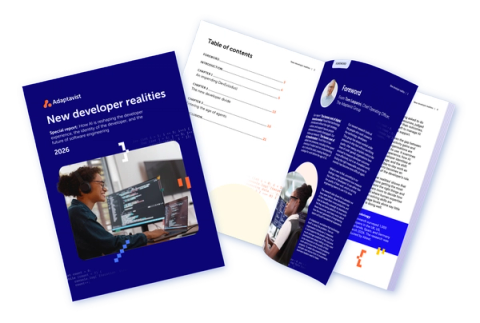
New developer realities research report

How is AI really impacting developers?

The landscape for developers is changing fast. From the growing divide between junior and mid-career employees to the skills required to manage AI agents, with experimentation and opportunity also come with pressure, uncertainty, and anxiety.
'New developer realities' shows how AI is introduced, managed, and measured matters just as much as whether it is used at all. The research report will help you understand the current shifts and adapt your AI strategy to meet today's challenges.
Inside, you'll find the complete results from the independent survey, in-depth analysis, and insights from Adaptavist experts and our strategic technology partners.

The way leaders are rolling out AI is putting pressure on engineering teams. Learn how to get it right with advice from the experts.
Written by
Matt Saunders
Matt Saunders
DevOps Lead
Matt Saunders heads up DevOps for the CTO function at Adaptavist. In a career ranging from challenger banks to the largest multi-national enterprises, Matt has helped organisations deliver software safer and faster, particularly within the unique constraints of those in the finance sector. Matt firmly believes that transformational work can be delivered even in the most constrained of companies.
AI
DevOps
Digital transformation